Famous Artists Every Child Should Know — with Art Activities for Each
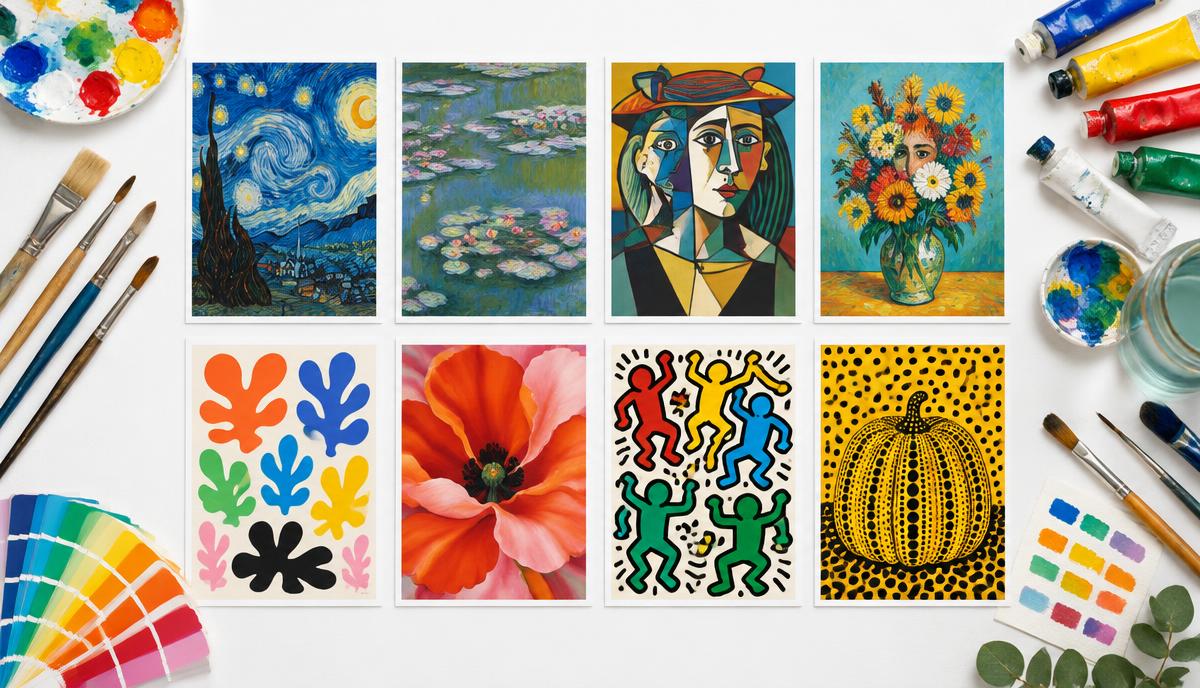
Introducing children to famous artists does more than fill a school project — it shows them that there is no single 'right' way to make art. Here are eight famous artists for kids to know, what makes each one special, and a simple art activity you can try at home for each.
Vincent van Gogh — bold colour and swirling brushstrokes
Van Gogh painted what he felt, not just what he saw. His thick, visible brushstrokes and swirling skies in 'The Starry Night' show children that energy and emotion belong in a painting.
Try at home: paint a night sky using short, curving strokes with a thick brush. Encourage your child to make the wind and stars 'move' rather than painting them perfectly.
Claude Monet — painting light and water
Monet and the Impressionists painted outdoors, chasing how light changes colour. His water lilies series is a gentle way to teach kids that the same subject can look completely different at different times of day.
Try at home: paint the same flower or toy twice — once near a sunny window, once in the shade — and compare the colours.
Pablo Picasso — seeing from many angles at once
Picasso's Cubist portraits show a face from the front and the side at the same time. Children love this because it gives them permission to break the rules of 'realistic' drawing.
Try at home: draw a self-portrait, cut it into pieces, and rearrange the pieces before gluing them down. Instant Cubism.
Frida Kahlo — art as self-expression
Frida Kahlo painted herself and her life with honesty and bold colour. She is a wonderful artist for teaching children that their own story, family and culture are worthy subjects for art.
Try at home: create a self-portrait surrounded by three things that matter to you — a pet, a favourite food, a place you love.
Henri Matisse — drawing with scissors
When illness made painting difficult, Matisse began 'painting with scissors' — cutting bright paper into organic shapes. His cut-outs prove that art materials can be as simple as paper and glue.
Try at home: cut free-form shapes from coloured paper and arrange them into a collage. No drawing allowed — scissors only.
Georgia O'Keeffe — looking closely at small things
O'Keeffe painted flowers and bones enormous, filling the whole canvas. She teaches children to slow down and really look at the small details of the natural world.
Try at home: pick one flower or leaf and draw it so big that it runs off the edges of the page.
Keith Haring — art that moves and speaks
Haring's bold outlines and dancing figures started as street art and carried big messages. He shows kids that simple lines can communicate energy, joy and ideas.
Try at home: draw a figure in motion using only thick outlines, then add 'movement lines' around it like Haring did.
Yayoi Kusama — patterns, dots and infinity
Kusama, a living Japanese artist, covers entire rooms in polka dots and pumpkins. Her work is a hit with children and shows how one simple repeated shape can fill a whole world.
Try at home: draw a pumpkin or any object, then cover it — and the background — entirely in dots and repeated patterns.
Why learning about artists matters for young artists
When children study famous artists, they build visual vocabulary — they learn to say 'this is like Monet's brushwork' or 'this is Cubist like Picasso'. That vocabulary becomes the foundation for composition, colour theory and technique as they grow.
In our art classes for kids, every term includes artist studies like these. Students recreate the masters' techniques, then apply them to their own original work — the same way artists have learned for centuries.
Let Your Child Learn Like the Masters
Our kids' art classes include guided artist studies, technique practice and original projects — at four studios across Singapore.
Explore Art Classes for KidsFrequently Asked Questions
What age should children start learning about famous artists?
From around age 4–5, children can enjoy artist-inspired activities like Matisse cut-outs or Kusama dots. Deeper discussion of styles and techniques suits ages 7 and up.
Which famous artist is best for kids to start with?
Van Gogh and Matisse are the most accessible — their styles are bold, forgiving and easy to recreate with basic materials at home.
Do art classes for kids include art history?
Good ones do. At The Art People, artist studies are built into the curriculum so children learn technique and art appreciation together.
How do artist studies help a child's own artwork?
Copying master techniques builds brush control, colour mixing and composition skills, which children then apply to their own original pieces.