Art and Maths for Kids: How Parents Can Nurture Problem-Solving Through Creativity
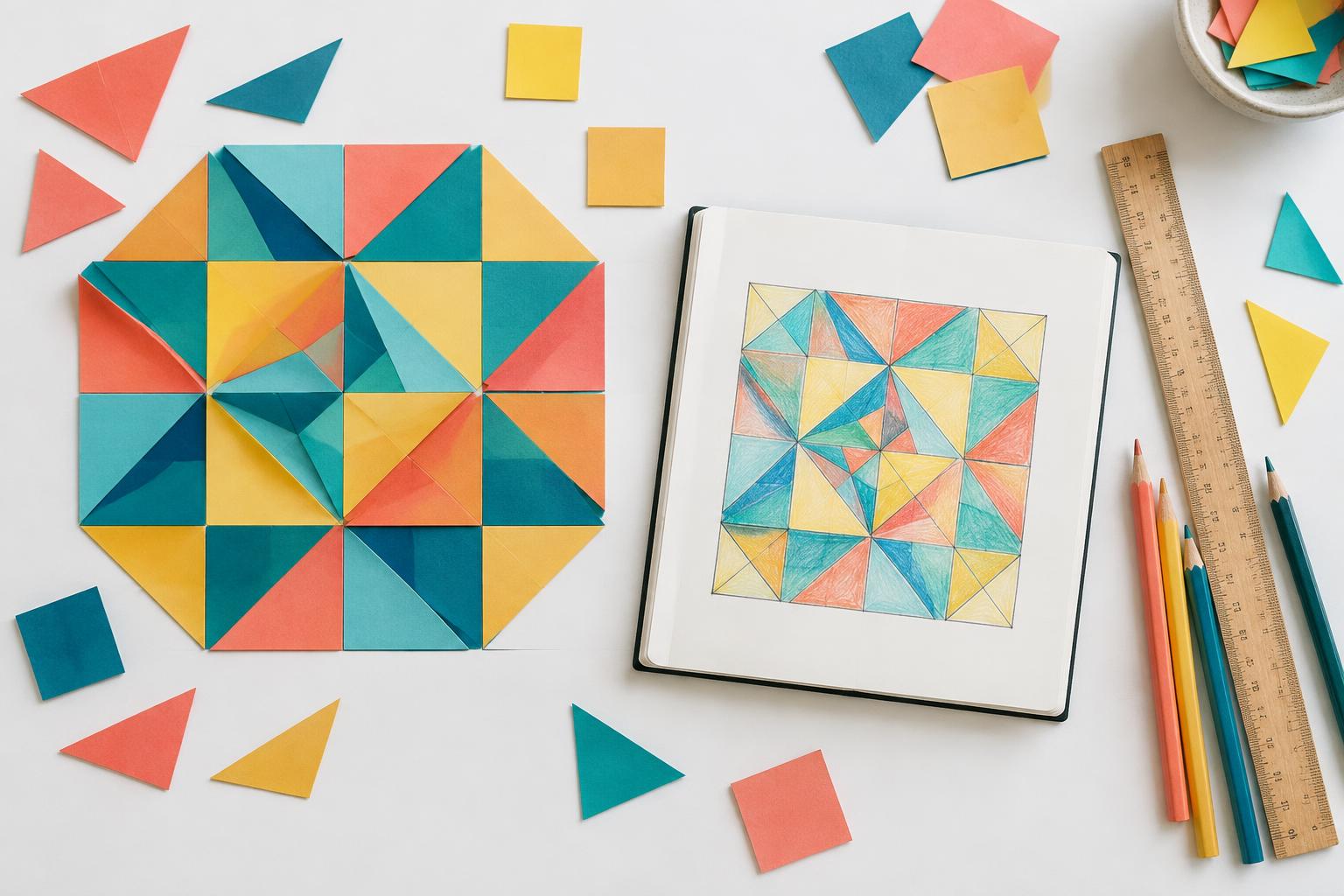
When a child arranges paper shapes into a picture, they are making more than an attractive design. They may be turning a triangle to fit a space, deciding whether two sides match, or working out what comes next in a repeating pattern. These are moments where artistic choices meet mathematical thinking. Parents do not need to turn every drawing session into a maths lesson. But recognising these connections can help them ask better questions, offer richer activities and notice learning that a finished picture alone does not reveal.
The Connection Is in the Thinking, Not Just the Shapes
Art and mathematics are different subjects, but some tasks ask children to attend to the same relationships: size, position, sequence, proportion and the way parts form a whole. Drawing a building involves deciding how windows fit into a wall. Making a border involves choosing and maintaining a repeating unit. Folding a design involves comparing one side with another. The mathematical opportunity lies in reasoning about those relationships, not simply in including a triangle in an artwork.
Consider two children making a patterned picture. One follows an adult's placement instructions. The other decides on a rule, predicts the next shape and explains why a piece does not fit. Their finished pictures might look similar, but their learning experiences are different. The second child has had more opportunity to make the underlying structure explicit.
That distinction matters in the Artlytical Method®. Art Core supplies the practical tools for making an image; Analytical Core helps children observe relationships, plan choices and evaluate the result. This article explores one application of that connection. It does not suggest that art lessons replace direct teaching in mathematics.
Spatial Reasoning: Imagining Before Moving
Spatial reasoning involves thinking about objects and their relationships in space. A child using a paper triangle may ask whether it will fit a gap if turned, whether a smaller piece is needed, or how several pieces could make a larger form. They can test a prediction with their hands and compare what happened with what they imagined.
At home, offer large, pre-cut paper shapes and invite your child to create an animal or a building. Before they move a piece, ask, 'Which way could you turn it?' If the question interrupts their flow, simply let them explore and discuss one choice afterwards. Moving, looking and trying again are part of the task, not evidence that a child has failed to understand it.
With a more experienced learner, invite two different arrangements using the same pieces. Can a wide creature become a tall one without adding shapes? This makes it possible to compare alternative solutions while leaving the artistic outcome open.
Pattern: Finding the Rule Beneath the Decoration
A repeating pattern has a unit that recurs. Red-blue-red-blue is different from a collection of colours that merely happens to look attractive. Asking a child to identify the smallest repeating part moves the conversation from appearance to structure.
Try a drawn or stamped border. Begin with a manageable unit such as circle-triangle, then ask your child to extend it. Next, cover a small part of the border and ask what would belong in the gap. The useful question is not only 'What comes next?' but 'How do you know?' An explanation can reveal whether the child is tracking the rule or guessing from the last mark.
Children who are ready for a greater challenge can keep the same rule while changing colours or shapes. They may discover that a pattern can remain structurally the same even when it looks different. Avoid correcting a decorative design as though it were a pattern exercise unless a repeating rule was actually the shared goal.
Symmetry and Proportion: Comparing Relationships
A folded-paper print makes symmetry tangible: paint one side, fold the paper, and examine the reflected marks. Discuss which features correspond across the fold. Explain that folding creates a reflection; drawing two roughly similar halves is not necessarily exact symmetry. A child can enjoy an imperfect print while still investigating the idea.
Proportion raises a different question: how does one part compare with another? When drawing a favourite cup, a learner can compare its height with its width or the handle with the body. Older children might use a consistent informal unit, such as the width of a paper strip, before moving to a ruler. The goal is to compare deliberately, not to force every drawing into perfect realism.
Art also allows purposeful departures from proportion. An enormous hand might make a character funny or dramatic. Asking whether a difference was intentional respects expression while helping the learner distinguish an expressive choice from a relationship they had not yet noticed.
A Practical Home Activity: Design a Shape City
Offer paper, pencils and large paper rectangles, squares and triangles. Use child-safe materials and supervise any cutting; younger children can work with shapes prepared by an adult. Invite your child to design a small city with three buildings, without showing a model they must reproduce. This is an illustrative home activity, not a prescribed Artlytical® lesson.
Start with a plan: which building will be tallest, and where will it go? Let your child arrange pieces before fixing them in place. Ask one focused question, such as 'How could these windows be evenly spaced?' Depending on readiness, the answer could involve comparing gaps by eye, using a paper spacer or measuring. Different levels of support can serve the same problem.
When the picture is complete, revisit a decision rather than grading its neatness. If a roof does not span a wall, compare the widths together and invite a choice: change the roof, change the wall or keep the unusual design intentionally. The learning is in identifying a relationship and deciding how to respond.
- Observe: Which shapes and sizes do you have?
- Plan: How will the buildings fit on the page?
- Test: Try an arrangement before gluing it down.
- Reflect: Which decision worked, and what would you change?
Helping Without Solving the Problem for Your Child
It is tempting to straighten the windows, complete the pattern or move the awkward piece. Those corrections may improve the picture, but they can remove a useful decision from the child's hands. A more productive intervention makes the problem visible and leaves the next step to the learner.
Instead of 'That is wrong,' try 'Compare these two gaps—what do you notice?' Instead of choosing the next colour, ask the child to point to the repeating unit. If they are overwhelmed, reduce the challenge: fewer shapes, a shorter sequence or one relationship to compare. Support should make participation possible, not become a test of how much frustration a child can tolerate.
Allow periods of making without questions. A conversation about one meaningful choice afterwards is often more useful than a stream of questions throughout. Art should remain an experience of expression and exploration, not a worksheet disguised as a painting.
What Parents Can Notice Over Time
Look for increasingly deliberate actions: turning a piece before rejecting it, naming a repeating rule, comparing sizes before drawing, or trying a second arrangement. Keep a few early plans alongside finished work. They make it easier to see how decisions develop, even when the final pictures are not becoming noticeably neater.
Useful praise describes a strategy: 'You checked the spaces before adding the windows' or 'You found another way to use the same shapes.' These comments connect progress to actions a child can repeat, rather than assigning a permanent label such as 'naturally good at maths'. Development is uneven, and one successful activity is not a measure of overall mathematical ability.
What These Connections Do—and Do Not—Establish
Harvard Project Zero's Studio Thinking work identifies habits such as envisioning, observing and reflecting within art-making. These offer useful language for discussing what a child does during a creative task. They do not establish that a particular art programme improves mathematics results, nor do they constitute an evaluation of the Artlytical Method®.
Transfer between subjects should not be assumed. A child who compares proportions in a drawing may still need explicit help recognising a related relationship in a geometry question. Parents can make a connection gently—'We compared widths in your city drawing too'—while continuing to support the actual mathematical concept being taught.
The strongest immediate case for these activities is straightforward: they give children meaningful opportunities to reason about spatial and numerical relationships while making something of their own. Art has value beyond academic outcomes. Its connection to mathematics adds another way to explore ideas; it is not a promise of higher marks.
Connecting Home Exploration with the Artlytical Method®
Our main Artlytical Method® article explains why craft and thinking belong together. This guide puts that principle into a parent-facing context: practical drawing skills make a design possible, while observation, planning and reflection help the child understand and improve it.
At home, begin with one enjoyable task and one relationship worth noticing. In an art class, ask not only what your child will make, but which skills they will practise and which decisions will remain theirs. That question shifts the focus from collecting pictures to developing a learner who can think through a visual problem.
Explore Thoughtful Art Learning for Your Child
Talk to The Art People about an art programme that brings practical skills and intentional visual decisions together.
Talk to Our TeamFrequently Asked Questions
How are art and maths connected for children?
Art activities can involve shapes, spatial relationships, repeating patterns, symmetry and proportion. The connection becomes meaningful when children compare, predict, explain and revise, rather than only copy a finished design.
Will art classes improve my child's maths marks?
No improvement in marks can be guaranteed. Art can provide opportunities to practise related reasoning, but using it in mathematics depends on explicit connections, subject teaching and the individual learner.
What is an easy art and maths activity to try at home?
Invite your child to build a picture with large paper shapes. Ask how a piece could be turned to fit, or compare the sizes of two parts. Older learners can explore spacing, symmetry or a repeating border.
What if my child does not enjoy maths?
Begin with an enjoyable creative task and avoid turning it into a quiz. Offer one observation or question when appropriate, and let the child retain ownership of the artwork. Art should not become a source of additional pressure.
How does this relate to the Artlytical Method®?
It illustrates the connection between Art Core, which develops practical making skills, and Analytical Core, which develops observation, planning and reflection. It is an application of the teaching rationale, not evidence of guaranteed academic outcomes.
Sources & Further Reading
- Studio Thinking: The Framework
A fuller explanation of studio habits such as Envision, including mentally picturing what cannot be directly observed. The connection to shape activities here is an educational application, not a claim of proven gains in maths scores.
- Harvard Project Zero: Eight Habits of Mind
Background on studio habits including Envision, Observe and Reflect. This resource describes learning in art, not guaranteed improvements in mathematics or an endorsement of our method.
- The Art People: The Artlytical Method®
Our explanation of Art Core and Analytical Core, the framework behind the connections discussed here.