The Artlytical Method® in the Real World: What a LEGO Brick Teaches Us About Design
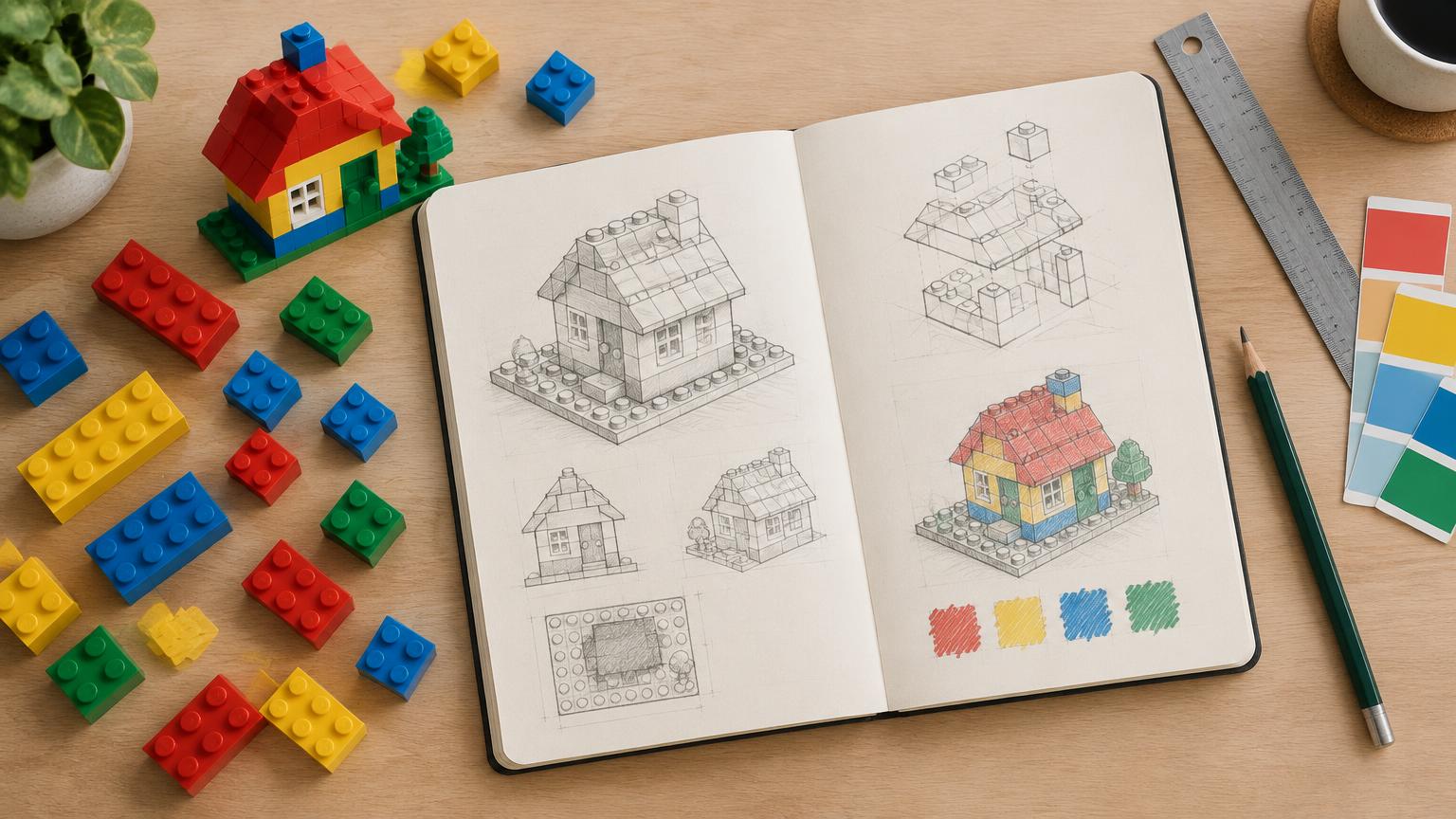
It is one thing to describe a teaching method in the abstract. It is another to see it at work in an object almost every family already owns. The LEGO brick is one of the most successful design products ever made: simple enough for a toddler, precise enough for an engineer, and unchanged in its essential form for decades. Look closely at why it works, and you find exactly the partnership the Artlytical Method® teaches—technical craft on one side, analytical thinking on the other. This article reads the brick through the method's five fixed areas, with the specific skills chosen from the product itself, and shows what that means for the way children learn art and design.
Why the LEGO Brick Is a Useful Case Study
A good case study needs to be familiar, successful and honest to examine. The LEGO brick qualifies on all three counts. Most children in Singapore have held one. The product has endured for generations while toys around it have come and gone. And because a brick is a physical object, we can point to concrete design decisions rather than vague claims about creativity.
It is also a product where success cannot be explained by appearance alone. A brick that merely looked cheerful but did not connect reliably would have failed. A brick that connected perfectly but offered no creative possibility would have been forgotten. Its success comes from the interaction between how it is made and how it is thought about—which is precisely the interaction the Artlytical Method®'s two pillars describe.
A note on scope: this article is an independent educational analysis. The Art People is not affiliated with or endorsed by the LEGO Group, and nothing here claims the company's designers used our framework. We are using a familiar product to make a teaching idea visible.
Art Core in the Brick: The Five Fixed Areas of Craft
The first pillar, Art Core, is about technical mastery. In the Artlytical Method® it is described through five fixed areas.
The five areas themselves never change — every case study walks through the same fixed structure: Visual Foundations, Spatial Intelligence, Technical Mastery, Expressive Refinement, Insight & Articulation. What is configurable is the specific skill chosen inside each area: a drawing lesson might choose pencil control as the specific of Visual Foundations, while this case study chooses something from the product itself. Here is each fixed area with its specific for the Art Core pillar:
Notice what this reading shows: none of these qualities is accidental. Each one is a technical decision, executed with discipline, in service of the user's experience. That is craft so reliable the user never has to think about it—the standard every Art Core area trains toward.
- Art Core, Visual Foundations – exact shapes and lines: the stud-and-tube geometry drawn to tolerances of hundredths of a millimetre.
- Art Core, Spatial Intelligence – a consistent modular grid: stud spacing that lets walls, roofs and wheel arches share the same parts.
- Art Core, Technical Mastery – disciplined manufacture: moulded plastic executed so precisely that a brick made decades ago still connects with one made today.
- Art Core, Expressive Refinement – colour and finish: a stable, bright palette and a smooth, durable surface that feels pleasant in the hand.
- Art Core, Insight & Articulation – refining errors: the hollow tubes underneath the studs, a quiet revision that solved grip and clutch problems.
Analytical Core in the Brick: The Five Fixed Areas of Thinking
The second pillar, Analytical Core, covers the thinking side through the same five fixed areas. Remarkably, the brick does not just benefit from these habits—it demands them from its user.
The five areas themselves never change — every case study walks through the same fixed structure: Visual Foundations, Spatial Intelligence, Technical Mastery, Expressive Refinement, Insight & Articulation. What is configurable is the specific skill chosen inside each area: a drawing lesson might choose pencil control as the specific of Visual Foundations, while this case study chooses something from the product itself. Here is each fixed area with its specific for the Analytical Core pillar:
A child building a bridge must observe the problem (how wide is the gap?), plan an approach (which pieces span it?), deconstruct the goal into parts (supports, deck, rails) and evaluate the result (does it hold?). This is the deeper point: analytical thinking is not a separate subject layered on top of making things. In successful design, the thinking is embedded in the object.
- Analytical Core, Visual Foundations – analysing the design: breaking the brick into its basic shapes and proportions to see why it works.
- Analytical Core, Spatial Intelligence – planning layout: deciding how parts will span a gap or carry a wall before building begins.
- Analytical Core, Technical Mastery – analysing process steps: studying why early bricks slipped, then testing alternative connections.
- Analytical Core, Expressive Refinement – explaining choices: every feature is an answer to a question someone asked about the user's experience.
- Analytical Core, Insight & Articulation – reflection: decades of iteration; the final form is analysis made permanent.
Where the Two Pillars Meet: The Real Lesson
Neither pillar alone explains the brick. Precision without creative possibility produces a perfect, useless component. Creative possibility without precision produces a frustrating toy that falls apart. The product succeeds because craft and analysis were developed together, each making the other valuable.
The same is true of a child's drawing. A student who can control a pencil but never plans a composition produces careful, empty pictures. A student full of ideas but without control of their tools produces frustration. The Artlytical Method® exists to develop both together, because real-world design—and real-world art—rewards exactly that combination.
This is also why we resist judging a lesson only by the finished picture. The brick's value is not in any single model built from it; it is in the repeatable capability it gives the builder. Likewise, the value of an art lesson is not only the artwork taken home, but the slightly more capable observer, planner and maker who takes it home.
What This Looks Like in Our Classrooms
In a typical project, a child might design and build a small structure or draw a designed object. The Art Core work is concrete: controlling lines, constructing forms, choosing colours with intention. The Analytical Core work runs alongside it: observing a real object before drawing it, sketching two possible layouts before committing, and checking the result against the original intention.
Because the five areas are fixed but the specifics are chosen, the same project can train very different skills for different children. One child's specific in Visual Foundations might be controlling line weight; another's might be recognising the basic shapes in a complex subject. The structure stays balanced and purposeful either way.
When something goes wrong—a tower that leans, a drawing where the proportions drift—the question is not 'is this good?' but 'what do you notice, and what will you try next?' That is the same loop the brick's designers ran, scaled to a child's level: observe, decide, make, check, revise. Over time, children stop waiting to be told the next step and begin to generate their own questions, test their own ideas and explain their own choices.
How Parents Can See the Method at Home
You do not need a classroom to watch these habits at work. The next time your child builds or draws, listen for the process rather than judging the product. A child who says 'this part keeps falling, so I made the base wider' is doing structural analysis. A child who tries a second colour scheme 'because the first one hid the door' is evaluating their own design decisions.
You can encourage the same loop with simple questions: What are you trying to make? What is the tricky part? What did you change, and did it work? These are not tests; they are invitations to make thinking visible. And when a project fails, treat it the way a designer treats a prototype—as information, not a verdict.
If your child enjoys this kind of thinking, structured art and design learning gives it somewhere to grow. The same partnership of craft and analysis runs through our drawing, painting and digital programmes, from a toddler's first controlled marks to a teenager's portfolio.
- Ask 'what are you trying to make?' before 'what is it?'
- Ask 'what did you change?' to surface revision and self-evaluation.
- Treat failed attempts as prototypes—information for the next try.
- Notice when your child explains a decision without prompting; that is the analytical habit taking root.
See the Method in a Real Lesson
The best way to understand the Artlytical Method® is to watch your child use it. Speak with our team about a trial class at one of our four Singapore studios.
Talk to Our TeamFrequently Asked Questions
What does a LEGO brick have to do with art education?
The brick is a real-world example of the two capabilities the Artlytical Method® teaches: technical craft (Art Core) and analytical thinking (Analytical Core). The article reads it through the method's five fixed areas—Visual Foundations, Spatial Intelligence, Technical Mastery, Expressive Refinement, and Insight & Articulation—choosing a specific example from the brick for each one.
What are the five areas of the Artlytical Method®?
Both pillars are described through the same five areas of the Design Matrix: Visual Foundations, Spatial Intelligence, Technical Mastery, Expressive Refinement, and Insight & Articulation. The areas are fixed and general; the specific skill inside each area (such as pencil control within Visual Foundations) is chosen for each child or lesson.
Is The Art People affiliated with LEGO?
No. This article is an independent educational analysis of a well-known product. The Art People has no affiliation with or endorsement from the LEGO Group; we use the brick purely as a familiar case study of design thinking.
Does the Artlytical Method® teach product design?
Not directly. It teaches the underlying capabilities—craft skills and visual thinking—that design, drawing, painting and digital media all rely on. The same observe-plan-make-revise loop appears in a child's drawing and in professional design work.
How can I encourage this kind of thinking at home?
Ask process questions instead of judging results: What are you trying to make? What is the tricky part? What did you change? Treat failed attempts as prototypes and information rather than mistakes.
Which programmes at The Art People use this approach?
All of them. The Artlytical Method® runs through our kids' art classes, toddler programme, sketching, and the Digital Tech Program including 3D design and animation—adjusted to each age and medium.
Sources & Further Reading
- The Art People: The Artlytical Method®
Our description of the Art Core and Analytical Core and the five fixed areas of the Design Matrix—the framework this case study applies to a real product.
- Harvard Project Zero: Eight Habits of Mind
Background reading on studio thinking, including Develop Craft, Observe and Reflect. Not an evaluation or endorsement of the Artlytical Method®.