The Artlytical Method® in the Real World: What a Pair of Orange Scissors Teaches Us About Design
Some design objects are so familiar that we stop seeing them. The orange-handled scissors found in classrooms, studios and homes around the world are one of those objects. They look simple, almost obvious. Yet behind that obviousness lies one of the most celebrated examples of design thinking in the twentieth century—a product that solved real problems through careful observation, relentless testing and superb craft. In this second real-world case study of the Artlytical Method®, we read the scissors through the method's five fixed areas, with the specific skills chosen from the tool itself, and ask what that teaches children who are learning art.
Why Scissors Are a Worthy Case Study
In our first case study, we examined the LEGO brick—a product whose success rests on precision and modularity. Scissors offer a different kind of lesson: a tool whose design is shaped entirely by the human hand and the task of cutting. Every curve of the handle and every angle of the blade exists because someone watched how people actually use the tool.
The orange-handled scissors introduced by the Finnish company Fiskars in 1967 became a design icon, eventually entering museum collections. Their story is well documented in design history, and it makes an ideal teaching example because children already know the tool. When a child in our studio picks up a pair of scissors, they are holding the result of exactly the kind of thinking we teach.
As before, a note on scope: this is an independent educational analysis. The Art People is not affiliated with or endorsed by Fiskars, and we do not claim their designers used our framework. We use a familiar object to make a teaching idea visible.
The Problem the Designers Observed
Before these scissors existed, most scissors were made entirely of steel. They were heavy, expensive, and their handles pressed uncomfortable loops of metal into the fingers during long use. Dressmakers and home users simply accepted this, because that was what scissors were.
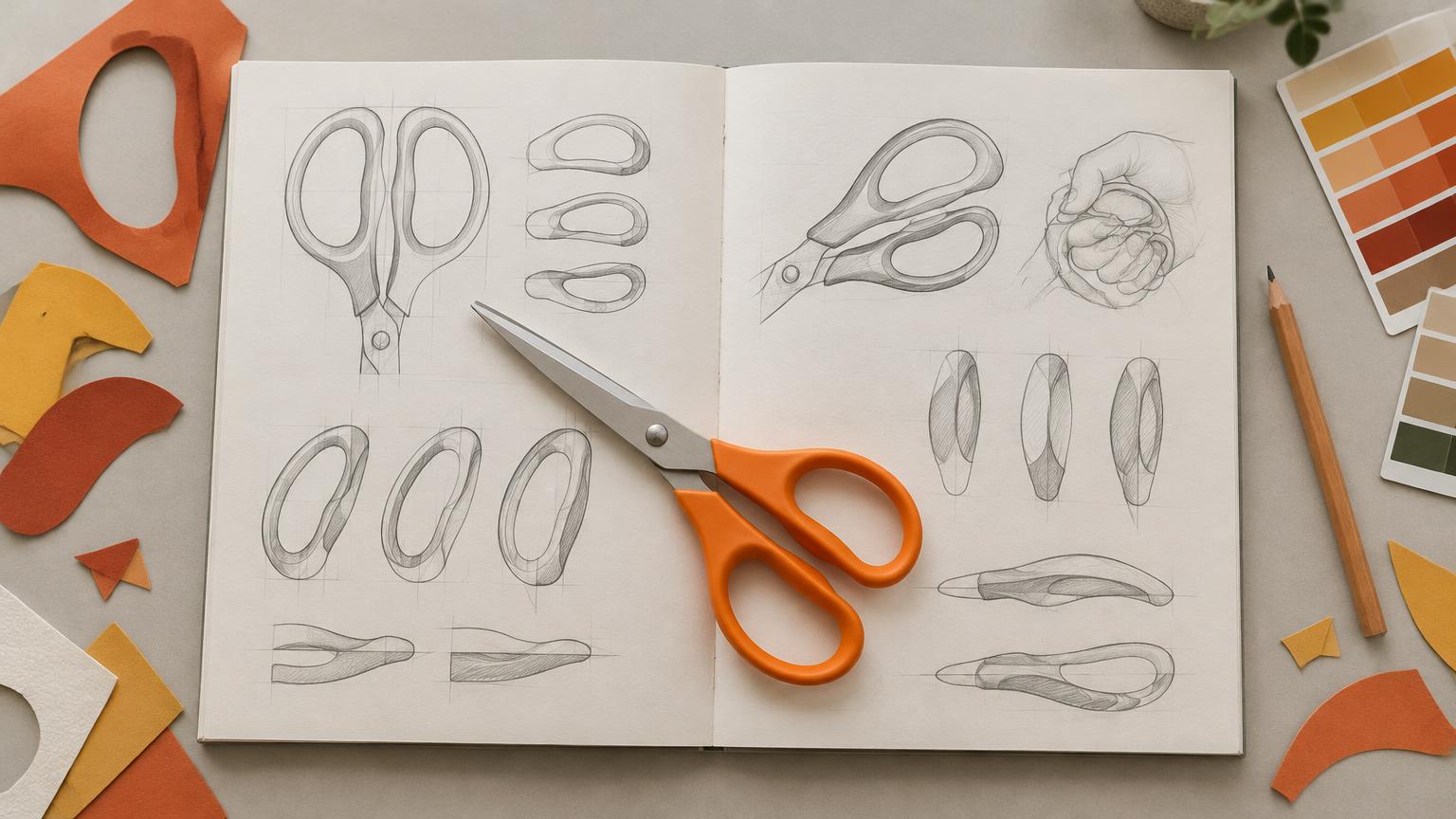
The design breakthrough began with observation—the first habit in our Analytical Core. The designers looked at how real hands hold scissors, where pressure builds up, and how the fingers actually move during cutting. They noticed that the thumb and fingers do different jobs, and that a handle shaped for those different jobs would be more comfortable than two identical metal loops.
This is a lesson worth stating plainly to children: good design does not start with drawing something pretty. It starts with looking carefully at a real problem. The same habit applies when a child draws a hand, a leaf or a shoe—the drawing improves the moment the child stops drawing what they assume and starts drawing what they observe.
Art Core in the Scissors: The Five Fixed Areas of Craft
The first pillar, Art Core, is about technical mastery. In the Artlytical Method® it is described through five fixed areas.
The five areas themselves never change — every case study walks through the same fixed structure: Visual Foundations, Spatial Intelligence, Technical Mastery, Expressive Refinement, Insight & Articulation. What is configurable is the specific skill chosen inside each area: a drawing lesson might choose pencil control as the specific of Visual Foundations, while this case study chooses something from the scissors themselves. Here is each fixed area with its specific for the Art Core pillar:
Every one of these is a technical decision executed with discipline: the right material, the right curve, the right edge, the right finish. Craft is not decoration added at the end. It is the means by which a good idea becomes an object that actually works.
- Art Core, Visual Foundations – the shaped line of the handles: curves drawn around what a real hand does during cutting.
- Art Core, Spatial Intelligence – the asymmetrical layout: a larger, shaped loop for the fingers and a smaller one for the thumb, sized to the different jobs each does.
- Art Core, Technical Mastery – blade craft: edges ground and set at an angle so they meet cleanly along their full length and leave the cutting line visible.
- Art Core, Expressive Refinement – the famous orange: a colour and finish so deliberate and recognisable that the company later protected it as a trademark.
- Art Core, Insight & Articulation – refining the form: successive revisions of the prototype's material, curve and finish until the tool felt effortless.
Analytical Core in the Scissors: The Five Fixed Areas of Thinking
The second pillar, Analytical Core, covers the thinking side through the same five fixed areas. The whole development story of the scissors is a study in these habits.
The five areas themselves never change — every case study walks through the same fixed structure: Visual Foundations, Spatial Intelligence, Technical Mastery, Expressive Refinement, Insight & Articulation. What is configurable is the specific skill chosen inside each area: a drawing lesson might choose pencil control as the specific of Visual Foundations, while this case study chooses something from the scissors themselves. Here is each fixed area with its specific for the Analytical Core pillar:
Notice the loop: observe the problem (tired fingers, heavy steel), plan a response (shaped plastic grips), make a version, check it against real use, and revise. That is the same observe-plan-make-check-revise cycle we ask children to practise when a drawing's proportions drift or a colour choice hides the subject. And there is a quieter lesson too: the design was evaluated against the user's experience, not against the designer's preference. We teach children the same check—'does it do what I wanted it to do?'—rather than a vague sense of 'good' or 'bad'.
- Analytical Core, Visual Foundations – analysing the design: observing how real hands hold scissors and where pressure builds up in long use.
- Analytical Core, Spatial Intelligence – planning layout: working out how blades, pivot and handles must relate for the cut to stay accurate and visible.
- Analytical Core, Technical Mastery – analysing execution: putting prototypes in users' hands, watching what actually happened, and studying the results.
- Analytical Core, Expressive Refinement – exploring variations: trying new materials and grips, and explaining why moulded plastic beat heavy steel.
- Analytical Core, Insight & Articulation – reflection: the final form is the residue of many evaluated attempts, each one checked against the user's experience.
What the Two Case Studies Teach Together
Put the brick and the scissors side by side and a pattern emerges. Both were read through the same five fixed areas—the structure never changes—but the specific skills inside each area were completely different, because the products are different. That is exactly how the Artlytical Method® works: the framework is fixed so that every lesson stays balanced, and the specifics are chosen so that every child's training fits what they need.
The brick shows craft and analysis in service of a system: precision that lets simple parts build anything. The scissors show craft and analysis in service of a person: observation of real hands, turned into a form that fits them. In both cases, neither pillar alone explains the success.
It is also why we encourage parents to look beyond the finished picture. The scissors in your drawer are not impressive because of how they look in a photograph. They are impressive because of the thinking embedded in them. A child's artwork deserves the same generous reading: what did they notice, what did they decide, what did they revise?
Bringing the Lesson Into the Classroom and Home
In our studios, everyday objects are some of the best teachers. A child drawing a pair of scissors must observe the asymmetry of the handles, the way the blades overlap, and how light falls on metal versus plastic. That is observational drawing, but it is also design education: the child begins to see that objects are the way they are for reasons.
At home, you can extend the same habit with any familiar object. Ask your child to look at a mug, a chair or their own shoes and answer: why is it shaped this way? What problem does this curve solve? What would you change? These questions turn looking into analysis, and analysis into drawing material.
When children learn to see the designed world this way, they stop being passive users of objects and become readers of them. That shift—from using to understanding—is exactly the shift the Artlytical Method® is built to create in their own making.
- Pick one everyday object and ask: why is it shaped this way?
- Ask what problem each part solves—handle, spout, hinge, grip.
- Invite your child to redesign one thing they use every day, and explain their choices.
- Notice when your child starts spotting design decisions unprompted—that is the analytical habit taking root.
See the Method in a Real Lesson
The best way to understand the Artlytical Method® is to watch your child use it. Speak with our team about a trial class at one of our four Singapore studios.
Talk to Our TeamFrequently Asked Questions
Why use scissors as a design case study for children?
Children already know and use scissors, so the example is concrete. The orange-handled design is a documented classic that shows how observing real users, prototyping and revising leads to a better product—the same habits the Artlytical Method® teaches in art lessons.
What are the five areas of the Artlytical Method®?
Both pillars are described through the same five areas of the Design Matrix: Visual Foundations, Spatial Intelligence, Technical Mastery, Expressive Refinement, and Insight & Articulation. The areas are fixed and general; the specific skill inside each area (such as pencil control within Visual Foundations) is chosen for each child or lesson.
Is The Art People affiliated with Fiskars?
No. This article is an independent educational analysis of a well-known product. The Art People has no affiliation with or endorsement from Fiskars; we use the scissors purely as a familiar case study of design thinking.
What is the difference between this case study and the LEGO brick article?
Both are read through the same five fixed areas, but the specifics differ: the brick shows craft and analysis in service of a system—precision and modularity—while the scissors show craft and analysis in service of a person—observing real hands and shaping the tool to fit them.
How does analysing products help a child learn to draw?
Analysing why an object is shaped the way it is trains observation—the foundation of good drawing. A child who notices the asymmetry of scissor handles or the curve of a mug is practising exactly the looking skills that improve their artwork.
Which programmes at The Art People teach this way of thinking?
All of them. The Artlytical Method® runs through our kids' art classes, toddler programme, sketching, and the Digital Tech Program including 3D design and animation—adjusted to each age and medium.
Sources & Further Reading
- The Art People: The Artlytical Method®
Our description of the Art Core and Analytical Core and the five fixed areas of the Design Matrix—the framework this case study applies to a real product.
- Harvard Project Zero: Eight Habits of Mind
Background reading on studio thinking, including Develop Craft, Observe and Reflect. Not an evaluation or endorsement of the Artlytical Method®.