Art and Science for Kids: How Drawing and Making Can Nurture Problem-Solving
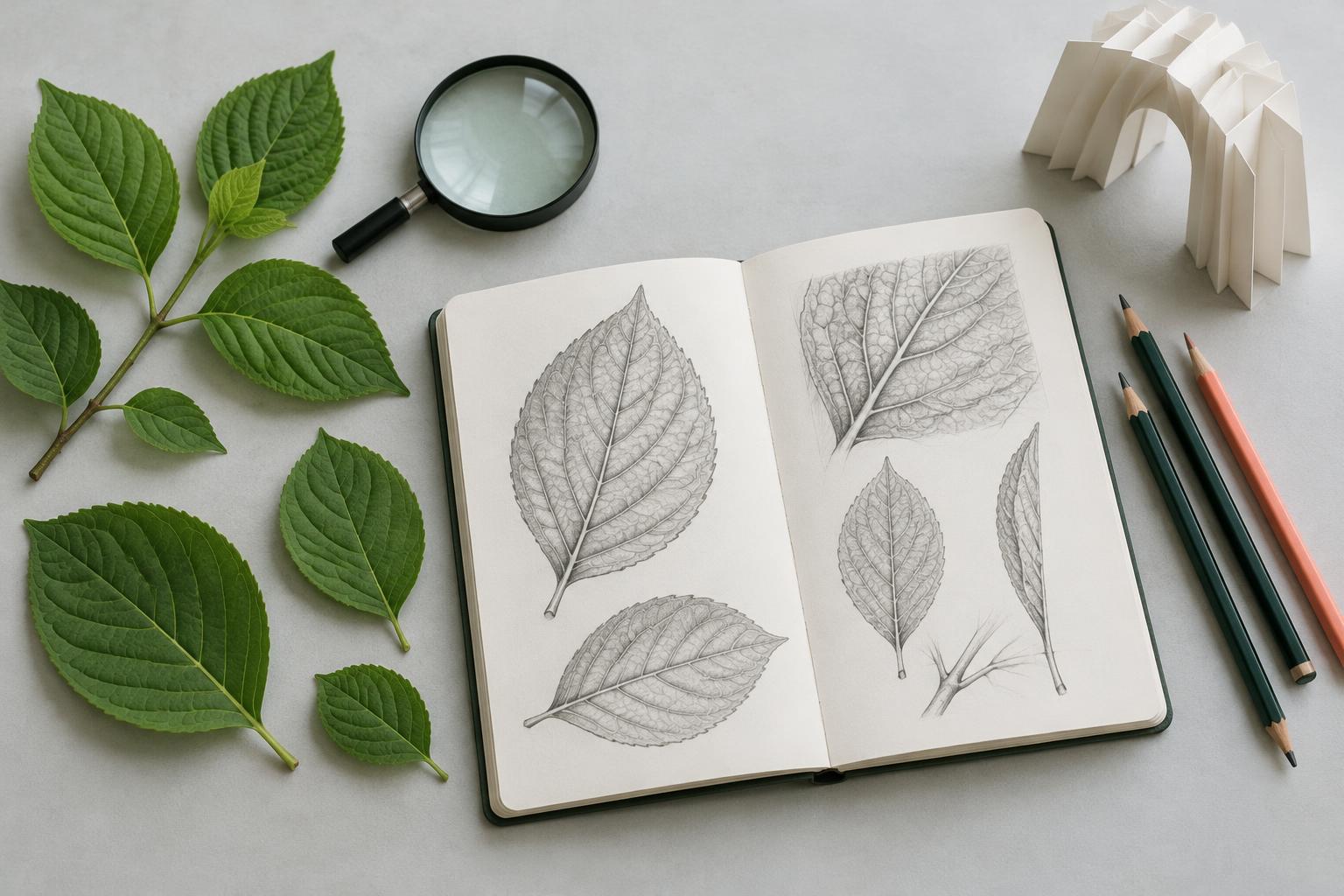
A child drawing a leaf may begin with the familiar symbol of a leaf: an oval, a stem and a few lines. Looking again can change the picture. Perhaps the edge is serrated, the veins branch at different angles, or one side is wider than the other. That moment—when a learner checks an assumption against something they can actually observe—is valuable in both art and science. Drawing and making give parents practical ways to encourage attention, questions and thoughtful revision, without turning a creative afternoon into a formal science lesson.
Why Observation Is More Than Looking
Looking at an object does not mean noticing its structure. We often recognise something quickly and then work from memory. A child can know that an object is a leaf without noticing how its veins are arranged. Observational drawing slows the process: the learner has to decide which features belong in the image and how they relate.
In science, careful observation helps distinguish what is present from what we expect to find. In art, it helps a learner move beyond a generic symbol towards the particular subject in front of them. The two activities are not identical, but both can benefit from asking, 'What can I actually see?' before deciding what it means.
At The Art People, this distinction connects with the Analytical Core of the Artlytical Method®. Observation informs a decision; Art Core gives the child tools to make that decision visible. The drawing becomes something the learner can compare with the subject and reconsider.
Separating Evidence from Interpretation
Suppose a child says, 'This leaf is sick.' That may be a possible explanation, but it is not a direct observation. 'There are brown patches near the edge' describes something visible. Helping children separate those statements opens a more useful conversation: what else might explain the patches, and what would we need to find out?
The same distinction can be practised with an artwork. 'The person is lonely' is an interpretation; 'The person stands apart from the group' points to visual evidence. Ask your child what they notice and what makes them think that. An interpretation need not be dismissed, but it can be supported or reconsidered.
This is not a demand that children speak like researchers. A simple three-part conversation—what do you see, what do you think, what do you wonder—can help them recognise that a question and an answer are different things. Adults should be willing to say 'We do not know yet' rather than fill every gap with a confident explanation.
Drawing as a Record of What a Child Notices
A drawing can serve as an observation record rather than a display piece. Place a familiar leaf or shell on a table and invite a first sketch. Then ask the child to choose one feature to examine more closely and make a second sketch. The comparison is about newly noticed information, not which picture looks more professional.
Older learners might add short labels, measurements or the date. If an object changes over time, consistent viewing conditions can make comparisons more meaningful. But a drawing is selective and can contain errors. It should not be treated as a precise measurement simply because the learner spent time on it.
Younger children may point to a detail, make a few marks or describe what they see instead of producing a recognisable drawing. The adult can record their words without replacing the child's marks. A manageable act of noticing is more valuable than a polished diagram made mostly by a parent.
Making, Testing and Revising: A Different Route into Problem-Solving
An art or design task often begins with an intention: make a paper structure stand, create a clear silhouette, or show a particular texture. The first attempt may not achieve it. That gap between intention and result creates a problem the child can investigate.
Instead of asking an adult for the correct answer, a learner can identify what happened, propose a change and test it. 'My structure fell sideways' is more informative than 'It is bad.' 'I will widen the base' gives a specific next step. Comparing the result helps the child decide whether the change served the goal.
This resembles aspects of scientific investigation and engineering design, but they should not be collapsed into one activity. An artistic choice may be judged by expression; an engineering choice may be judged by whether a structure meets a constraint; a scientific explanation requires evidence about how something works. Recognising the differences keeps the connection honest.
A Home Investigation: Can Your Paper Sculpture Stand?
Provide paper or thin card and invite your child to make a small freestanding sculpture. Use age-appropriate materials, supervise cutting and keep small items away from children who may put them in their mouths. The challenge is to make something they find interesting that can stand without a hand holding it. This is an illustrative home activity, not a report of a particular class.
Before making, invite a quick sketch or a verbal plan. After the first attempt, observe together: does it lean, slide or collapse? Choose one adjustment, such as widening the base or adding a fold, while keeping other features as similar as practical. Testing on the same level surface makes the comparison fairer.
A change can alter more than one property. Adding a fold may change both stiffness and shape, so the result does not prove a single cause. Parents can model a careful conclusion: 'This version stood better in our test; the fold may have helped.' That is more useful than announcing a universal rule from one trial.
Once the structure stands, bring expression back into the conversation. What could its shape communicate? Could it become an arch, a creature or an abstract sculpture? The investigation supports the artwork; it need not take over the entire experience.
- Set an intention: What do you want the sculpture to do?
- Make a prediction: Which part might help it stand?
- Observe the test: Describe what happened before explaining why.
- Revise deliberately: Change one feature and compare the versions.
- Keep the creative choice: Decide what the finished form should express.
Why an Unsuccessful Attempt Can Be Useful
A failed attempt is informative only when the learner has enough support to understand what happened and choose a next step. Repeating a frustrating task without feedback does not automatically build resilience. Nor does telling a child to 'try harder' identify the problem.
If a structure keeps collapsing, help narrow the difficulty. Look at the base, the folds or the point where it leans. Offer a short demonstration on a separate piece if needed, then let the child decide how to use it. Taking a break or simplifying the task is legitimate; persistence should not mean pushing through distress.
Praise the useful action, not failure itself: 'You checked where it bent before changing it.' The aim is to make revision purposeful. A learner should gradually develop options for responding to difficulty, rather than learn that the adult values endless effort regardless of what it achieves.
The Parent's Role: Curious Partner, Not Answer Machine
Children often look to adults for a quick verdict. A parent can redirect that request without withholding all help: 'Let us compare it with the leaf' or 'What happened when you tested it?' The subject or the test becomes another source of information, rather than the adult's approval being the only measure.
Ask fewer, more purposeful questions. 'Which detail surprised you?' can prompt reflection after a drawing. 'What would you keep the same next time?' can improve a comparison. Avoid questioning every mark or requiring an explanation for every creative impulse; sometimes children need uninterrupted time to explore.
When a child raises a scientific question you cannot answer, make uncertainty visible. You can record the question, consult a reliable age-appropriate source and return to it together. Guessing confidently can teach the wrong lesson about evidence. Curiosity includes knowing when more information is needed.
What the Educational Evidence Can Tell Us
Harvard Project Zero describes Observe, Reflect, and Stretch & Explore among the Studio Habits of Mind. These are useful ways of naming attention, reconsideration and experimentation within art education. The source supports a discussion of artistic learning; it does not prove that the Artlytical Method® produces higher science scores.
The activities in this guide are opportunities to practise noticing, recording and testing. Whether a child uses those habits in school science depends on teaching, context and the learner. Direct science instruction remains important, especially for concepts that cannot be established through everyday observation alone.
The wider promise should therefore be framed carefully. Art can give children a concrete setting in which to ask questions and revise an idea. That is worthwhile without claiming guaranteed academic improvement, a clinical benefit or a special ability to transform every child into a scientist.
How This Supports the Artlytical® Approach
The main Artlytical Method® article explains the partnership between practical craft and visual thinking. Observational drawing and purposeful making show why that partnership matters. Pencil control helps record a feature; observation helps decide which feature matters. Folding skill makes a structure possible; reflection helps decide what to change.
Parents can support the same partnership by valuing work in progress: the first sketch, the test that did not work and the explanation for a change. These traces reveal thinking that a finished artwork can conceal. The goal is not to make art serve only science, but to help children become more attentive and intentional in their own making.
Make Room for Craft, Curiosity and Thoughtful Choices
Speak with The Art People about your child's interests and an art programme that connects practical skills with visual thinking.
Talk to Our TeamFrequently Asked Questions
How can art connect with science learning?
Observational drawing can help children attend to and record visible features. Making and revising a design can provide a setting for predictions, tests and comparisons. These connections complement, rather than replace, science teaching.
Does observational drawing need to be realistic?
No. The useful goal is to notice and record something about the subject at a level the child can manage. A few deliberate marks or a spoken observation may be more appropriate than a detailed diagram.
What is a simple art and science activity for children?
Try two sketches of the same leaf, looking more closely at one feature before the second sketch. Another option is a supervised paper sculpture task: predict how it will stand, test it and compare a revised version.
Will these activities improve science grades?
That cannot be guaranteed. These tasks offer practice in observation and thoughtful revision, but academic outcomes depend on many factors and the specific science knowledge being taught.
How is this connected to the Artlytical Method®?
Art Core provides the skills to draw and make; Analytical Core supports observing, planning and evaluating. These home examples illustrate how the two can work together without claiming that our framework has been independently proven to improve science attainment.
Sources & Further Reading
- NAEYC: Preschoolers as Eco-Artists
An early-childhood education resource exploring art with natural materials, close attention and creative inquiry. It offers teaching examples, not an evaluation of our programme or a guarantee of academic improvement.
- Harvard Project Zero: Eight Habits of Mind
Background on observation, reflection and exploration within studio learning. It is not evidence of guaranteed science attainment or an evaluation of the Artlytical Method®.
- The Art People: The Artlytical Method®
Our description of the two pillars that connect making skills with intentional visual thinking.